
Synopsis:
OEM parts restore your vehicle to manufacturer safety standards after a collision. Redeemed Auto Body explains how part selection affects crash performance, fit, and long-term value, helping drivers choose an auto body shop in West Monroe, LA that prioritizes proper repairs over shortcuts.
When your vehicle is damaged in an accident, the most visible part of the repair is what you can see: straight panels, fresh paint, clean lines. What goes into the repair matters as much as how it looks, because the parts used affect both safety and long-term performance. OEM parts, made to your vehicle manufacturer’s exact specifications, are what make the difference between a vehicle that’s been properly restored and one that only looks like it has.
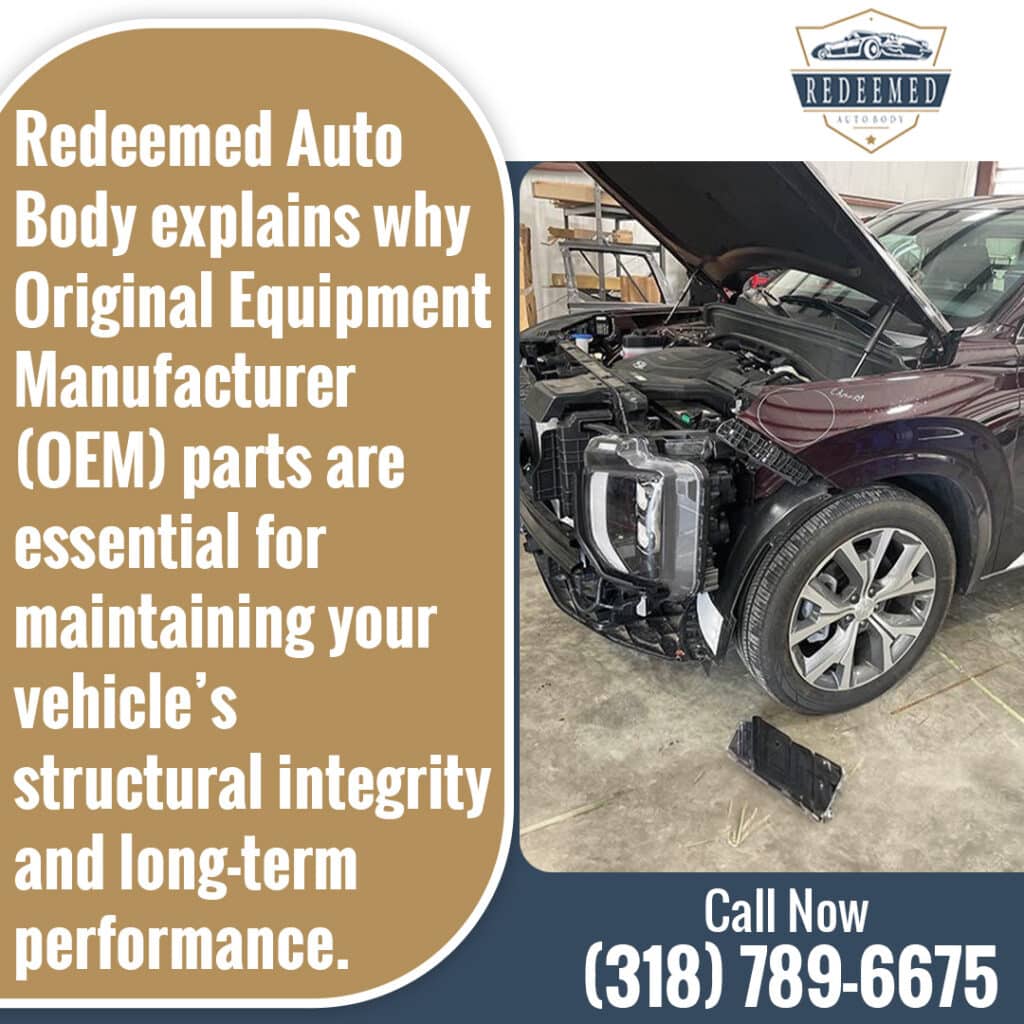
If you’re researching auto body repair in West Monroe, LA, after an accident, understanding your shop’s parts policy is one of the most important steps before approving any work. Redeemed Auto Body breaks down what OEM parts are, how they compare to alternatives, and why they directly affect your vehicle’s safety, fit, and long-term condition.
What Are OEM Parts and What Makes Them Different?
OEM stands for Original Equipment Manufacturer. These are components produced by your vehicle’s manufacturer or built to that maker’s exact engineering specifications, and used to restore your car after a collision.
Two types of replacement parts are common in the auto body repair industry:
- OEM parts: built using your manufacturer’s blueprints, with the same materials, dimensions, and tolerances as your car’s original components
- Aftermarket parts: produced by third-party suppliers with no manufacturer affiliation; quality ranges widely depending on the brand and part type
At our auto body shop in West Monroe, LA, the default is OEM. When a customer wants to explore a more economical option for a non-structural component, we explain the tradeoffs honestly, but we never use a lower-grade part without your knowledge, and we never substitute structural components regardless of cost.
The core advantage of OEM parts is specificity. They are engineered for your exact make, model, and year; not adapted from a design meant to fit a range of vehicles. That precision affects fit, material performance, and how the part holds up if your vehicle is involved in another accident.
Why Part Type Affects Safety; Not Just Appearance
After a collision, it’s tempting to focus on the cosmetic result. But the parts installed during a repair also affect how your vehicle responds in a future crash, particularly when structural components are involved.
Structural Parts and Crash Performance
Vehicle manufacturers use specific materials in structural components such as frame rails, pillars, and supports. These materials control how crash energy moves through the vehicle. Thickness, grade, and geometry are calculated to manage how crash energy moves through the vehicle and away from occupants.
When a replacement part doesn’t match those specifications, crash performance can change in ways that aren’t visible until they matter most. Studies reviewed by the U.S. General Accounting Office found that some aftermarket parts may not match OEM fit, durability, or safety standards.
The Insurance Institute for Highway Safety identifies structural components as the area where part sourcing matters most, noting that structural replacement parts must “exactly replicate the original parts to preserve the integrity of a vehicle’s crashworthiness.”
Fit, Finish, and Long-Term Durability
For cosmetic components: bumper covers, fenders, and hoods, the safety stakes are lower, but fit still matters. Aftermarket parts are sometimes manufactured to fit a broad range of vehicles, which can result in small panel gaps, misaligned body lines, or uneven surfaces after a repair is complete.
Poor fit affects more than appearance. Gaps in body panels change how moisture and road debris interact with your vehicle’s surface. Over time, this accelerates paint wear and promotes corrosion, a real concern in Louisiana’s humid climate.
OEM vs. Aftermarket Parts: A Comparison
The differences between OEM and aftermarket parts are easier to understand when compared side by side:
| Factor | OEM Parts | Aftermarket Parts |
| Fit | Exact; no modification needed | May need trimming or adjustment |
| Material spec | Matches the manufacturer’s requirement | Varies by supplier |
| Testing standard | Manufacturer-validated | Third-party certified; quality varies |
| Warranty | Typically carries the manufacturer’s warranty | Limited or none, varies by brand |
| Traceability | Full manufacturer part numbers | Varies |
Understanding “Like Kind and Quality”
Many insurance policies cover repairs using parts described as “like kind and quality”; language that allows insurers to authorize aftermarket components instead of OEM parts. In practice, this means the replacement should restore your vehicle to its pre-loss condition.
Whether a specific aftermarket part meets that standard depends on the part type and the supplier. For non-structural cosmetic components on older vehicles, a quality aftermarket part can be a reasonable option. For structural repairs, or for newer vehicles where parts interface with sensors and electronics, that standard is much harder to verify without OEM specifications as the benchmark.
This is one of the most common points of dispute between shops and insurance adjusters, and understanding it puts you in a better position when repair decisions are being made about your vehicle.
Our Parts Policy and How We Apply It
At Redeemed Auto Body, OEM parts are our default, not a premium option. We use OEM factory parts whenever possible, and we never substitute structural or safety-critical components with alternatives that don’t meet manufacturer specifications. This is documented at the start of every repair and disclosed in writing before work begins. Redeemed Auto Body is an auto body specialist that West Monroe, LA, drivers rely on for repairs that follow manufacturer standards.
When a customer wants to consider a more economical part for a non-structural component, we walk through the tradeoffs clearly and let the customer decide. What we don’t do is make that substitution without your knowledge.
Repair Documentation You Can Verify
Every repair is documented in a Google Drive folder shared with you before work begins. That folder includes the OEM repair procedures pulled for your specific vehicle, photos taken throughout the repair, and parts records with manufacturer part numbers, so you can confirm exactly what went into your car.
Before any work starts, we conduct a full pre-scan of your vehicle’s electronic systems to identify fault codes and hidden damage. After the repair, a post-scan confirms that all systems are functioning correctly. A part that doesn’t interface properly with your vehicle’s electronics will typically show up in the post-scan before your vehicle leaves the shop.
Equipment That Backs Up Our Standards
We use the Spanesi Touch frame measuring system to verify structural alignment against manufacturer specifications during the repair process. Our measurements are precise, not estimated visually.
For paint, we use the AkzoNobel system with an AkzoNobel computerized color matching camera. Color matching is a service we provide on every paint repair, identifying the exact formulation for your vehicle’s finish for a factory-accurate, undetectable result.
Here is what a Google review by Michael S. said about us. “I highly recommend Redeemed Body Shop. The team is friendly, professional, and knowledgeable. The (sic) did a great job on my son’s car a few months ago, finding it hard to get parts, so I took our Ford in and again was very satisfied.”
When OEM Parts Matter Most
Structural Frame and Rail Repairs
Frame rails, pillars, floor pans, and core support structures must meet OEM specifications without exception. These components directly determine how your vehicle manages crash energy. We do not substitute structural parts regardless of insurance cost pressure.
Newer Vehicles with Integrated Technology
On vehicles from roughly the last five to seven years, sensors and cameras are often mounted within body panels, bumpers, and mirrors. A replacement part that shifts a sensor’s position can affect whether those systems calibrate correctly after the repair. The more technology is integrated into a vehicle, the more exact its replacement parts need to be.
Higher-Value Vehicles and Resale Documentation
For higher-value vehicles, repair quality and documentation matter when it comes time to sell or trade in. OEM parts combined with the complete repair records we provide give you a clear, verifiable account of how your vehicle was restored, and that transparency carries weight with buyers and dealers alike.
How to Confirm the Parts Used in Your Repair
Before accepting your vehicle after any auto body repair services, it is important to confirm exactly what parts were used and how the repair was completed. Ask these questions:
- Can I see the parts invoices? OEM parts carry manufacturer part numbers that can be independently verified.
- Were manufacturer procedures followed? The shop should be able to show you the repair specification for your vehicle’s make, model, and year.
- Was a post-scan completed? A completed post-scan confirms that all electronic systems were checked after the repair.
- Is everything in writing? A reputable shop provides documentation without being asked.
At our shop, this is all included in the Google Drive folder every customer receives automatically.
Frequently Asked Questions
Do I have to accept aftermarket parts if my insurer requires them?
No. You have the right to request OEM parts, and we advocate for them on your behalf. Insurance policies generally require that your vehicle be returned to pre-loss condition, and we work directly with your insurer to make sure that standard is met.
How do I know what parts were used in my repair?
Ask for parts invoices with manufacturer part numbers. We include this in the repair documentation provided to every customer from the start.
You work with all insurance companies. Does that mean you still put my interests first?
Yes, we work with insurers to process your claim, but our focus stays on the repair your vehicle requires. Our obligation is to the vehicle owner, not the insurance company. We push for the repair your vehicle actually needs and keep you updated at least twice a week throughout the process.
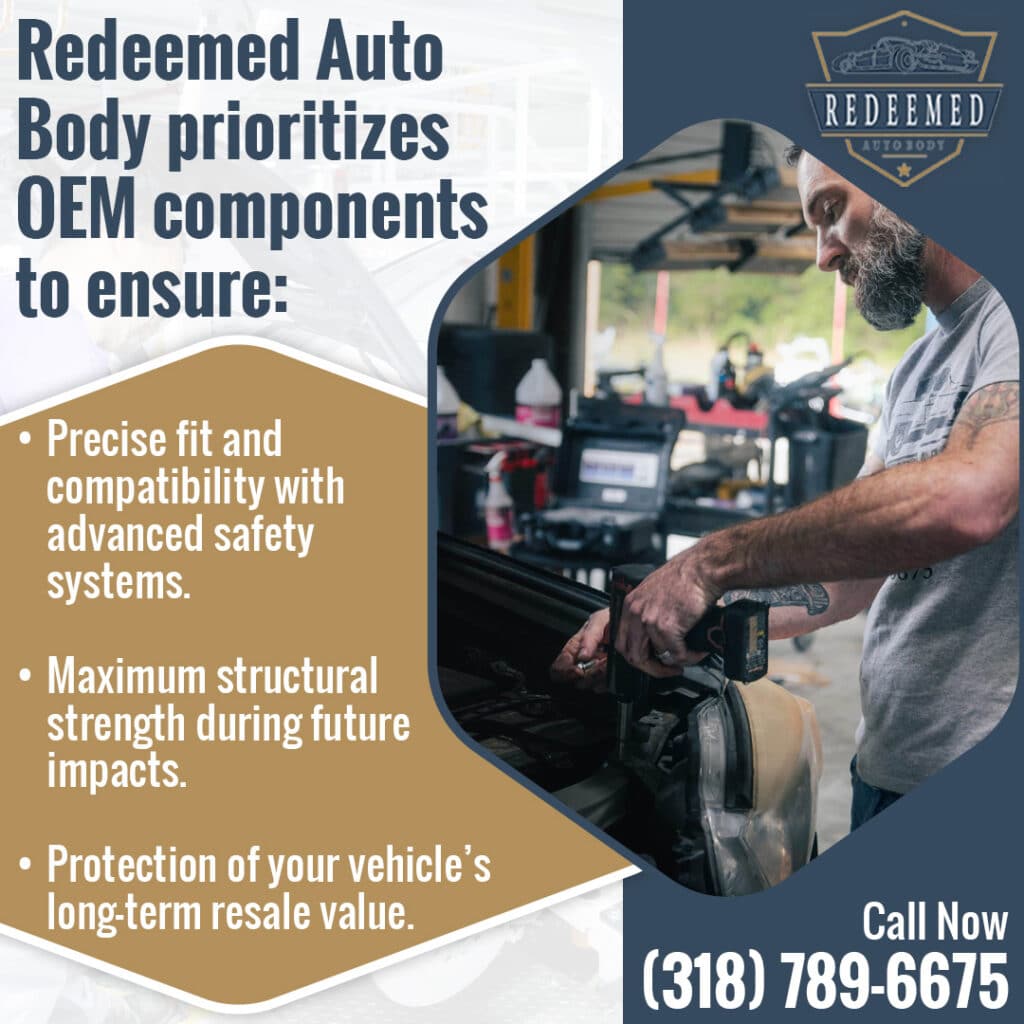
Get Your Vehicle Repaired to the Standard It Deserves
The parts in your repair determine whether your vehicle is truly restored or just reassembled. OEM parts, combined with manufacturer procedures, precision equipment, and verified documentation, give your vehicle the best chance of performing exactly as it was built to.
If you’re looking for an auto body shop in West Monroe, LA, where the repair is done right, not just fast, we’d welcome the conversation. Choosing where to have your autobody repairs done is a decision worth making carefully, and the shop’s parts policy is one of the first things worth asking about.
Schedule Your Free Consultation
Redeemed Auto Body offers free consultations and builds a complete OEM repair plan before any work begins. We use OEM factory parts and procedures, perform pre- and post-repair scanning, provide color matching with the AkzoNobel system, and back every repair with a Limited Lifetime Warranty on workmanship and paint. We also manage your insurance claim from start to finish.
Call us at (318) 789-6675 or email us at redeemedautobody@gmail.com to book an appointment. Not all body shops are the same. Are you searching for auto body repairs near you? Choosing a shop that prioritizes OEM parts and proper procedures will make a difference in how your vehicle performs after the repair. Let us show you the difference, take advantage of our quality services, multiple warranties, and discounts.