Synopsis
Insurance steering can influence where your vehicle gets repaired before you know you have a choice. Redeemed Auto Body explains how steering works, your legal rights in Louisiana, and why choosing a collision repair shop that follows proper repair procedures can affect safety, value, and the outcome of your claim.
When you file an auto insurance claim after an accident, the first conversation sets the tone for everything that follows. Within minutes, many drivers receive a shop recommendation they didn’t ask for and don’t realize they’re free to decline. This practice is called insurance steering, and it shapes where thousands of vehicles get repaired every year, often without the driver fully understanding what happened.
Redeemed Auto Body has been offering collision repair services in West Monroe, LA, since 2020. We work with drivers at every stage of this process. Some call us before filing a claim. Others arrive after already feeling pressured toward a shop they didn’t choose. Regardless of where you are in the process, knowing how steering works puts you in a better position to make the right call for your vehicle.
What Insurance Steering Actually Means
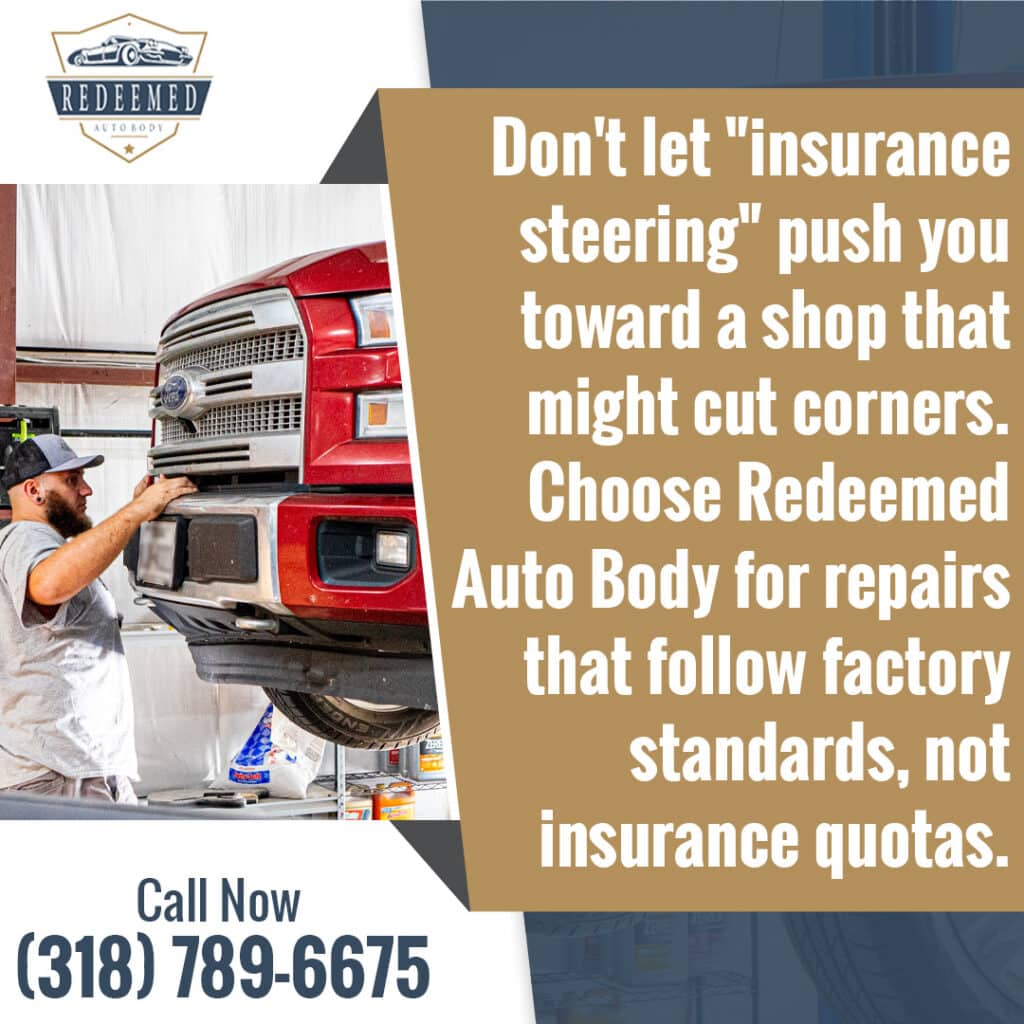
Insurance steering happens when an insurer, through its claims process or representatives, pushes a policyholder toward a specific repair facility, usually one participating in its Direct Repair Program (DRP) network.
A DRP is a contractual arrangement between an insurance company and a repair shop. The shop agrees to set labor rates, sourcing guidelines for parts, and repair turnaround timelines. In exchange, the insurer directs claim customers to that facility. The agreement benefits the insurer’s claims budget. Whether it benefits the vehicle owner depends on how that shop balances repair quality against the cost pressures built into the contract.
Why Insurers Have Preferred Shops
The underlying financial reasons are clear:
- Fixed labor rates lower what the insurer pays per repair
- Parts agreements favoring aftermarket over OEM components reduce claim costs
- Shorter repair timelines cut rental vehicle reimbursements
- Centralized billing with contracted shops reduces administrative work
Most drivers don’t know these trade-offs exist, or that their choice of collision repair shop determines how those trade-offs play out on their specific vehicle.
Louisiana Law and Your Right to Choose
In Louisiana, you have the legal right to choose any licensed repair facility after a collision. Your insurer cannot make that decision for you.
Louisiana Act 317, signed into law in 2019, strengthened that protection. If an insurer recommends a specific shop, it must clearly inform the policyholder that using it is not required.
Violations carry the following fines:
- First offense: $1,000
- Second offense within 12 months: $2,500
- Third or subsequent offense within 12 months: $5,000
The Louisiana Insurance Commissioner holds the authority to suspend or revoke licenses for ongoing violations. Where you take your vehicle for auto collision repair directly affects structural safety, how your vehicle’s safety systems perform, and what your car is worth at resale.
How Steering Plays Out During a Claim
Most drivers don’t recognize steering as it happens. The language is calm, helpful-sounding, and often comes early in the claims call before you’ve had time to think through your options.
Step 1: The Initial Call
You report the accident. The claims representative collects the details and then, often before you’ve asked, mentions: “We have a network of preferred shops in your area that work directly with us. They can usually get repairs started quickly.” This sounds like a time-saving tip. It functions as a referral to a shop that has agreed to handle repairs on the insurer’s financial terms.
Step 2: The Convenience Pitch
If you don’t immediately agree to the preferred shop, the framing tends to shift toward convenience:
- “The process is smoother when we’re already set up with the shop.”
- “They handle direct billing; less paperwork on your end.”
- “Repairs usually move faster through our network.”
These points are accurate from the insurer’s perspective. The paperwork is faster for them. The billing is simpler for their claims department. What they don’t address is whether the shop will follow manufacturer repair procedures or use OEM parts on your specific vehicle.
Step 3: Implied Difficulty With Independent Shops
If you name a shop you trust or ask to use one outside the network, the conversation may take on a different tone:
- “We’ve had some back-and-forth with that shop in the past.”
- “It might take longer to get approvals if they’re not in our system.”
- “You could end up waiting on things if they’re not familiar with our process.”
These statements create doubt without providing facts. Independent auto collision repair shops handle insurer communications, approvals, and documentation every day. The process is not more difficult; it simply involves a shop that isn’t contracted to meet the insurer’s cost targets.
What Steering Can Mean for Your Repair
Understanding why the shop choice matters goes beyond convenience. It affects what actually happens to your vehicle.
Repair Procedures and Manufacturer Standards
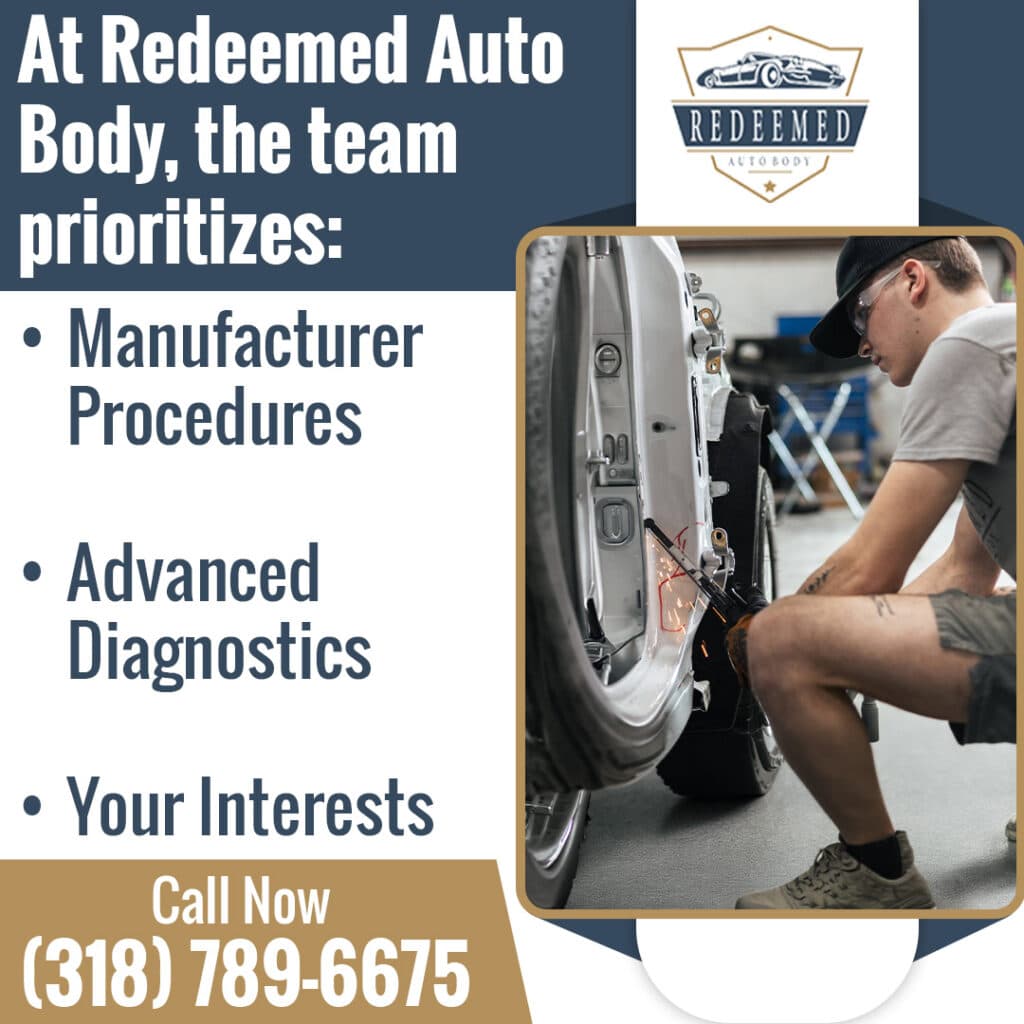
Every vehicle manufacturer publishes specific repair procedures that must be followed to restore structural integrity, safety system function, and crash performance. These aren’t suggestions; they’re requirements for the repair to be complete and safe.
DRP shops operating under tight cycle-time and cost agreements may face pressure that makes strict OEM compliance harder to maintain on every job. Our repair process at Redeemed Auto Body begins with pulling the applicable OEM procedures for your specific vehicle and year, and those procedures guide every step, from frame measurement through final quality control.
Structural Measurement
Frame alignment is where a repair either meets factory specifications or doesn’t. We use the Spanesi Touch measuring system to map your vehicle’s structure against manufacturer tolerances in three dimensions. A frame that looks straight may still be off in ways that affect panel fitment, door function, and, more critically, how the vehicle performs structurally in a future accident.
Scanning and Diagnostics
Modern vehicles carry complex electronic systems that require checking before and after any structural repair. We perform pre-repair and post-repair scans using AirPro and Opus diagnostic tools to identify fault codes, document existing conditions, and verify system integrity after repairs are complete. Skipping this step, which may happen more often than drivers realize, can leave sensors, safety systems, and driver assistance features operating incorrectly.
Color Matching and Paint Quality
A repair that leaves a visible color difference tells the story of the accident every time the vehicle is seen. We use the AkzoNobel paint system with its computerized color-matching camera to determine the precise formulation for your vehicle. On metallic, pearl, and tri-coat finishes, especially, this level of precision is the difference between a repair that disappears and one that announces itself.
The Independent Shop Difference
We carry zero DRP agreements. That choice reflects a specific commitment: when we write a repair plan, we answer to you, not to an insurer’s cost targets.
What that means in practice:
- We pull OEM repair procedures for every job and follow them as written
- We use OEM parts as the default; we do not substitute structural aftermarket components regardless of cost pressure
- We communicate directly with your insurer on approvals, supplements, and documentation. You don’t have to handle that alone
- If the initial insurance estimate doesn’t cover a complete, safe repair, we document the discrepancy and have that conversation with the adjuster
We also give every customer a dedicated Google Drive link with their full repair file: pre-repair photos, OEM procedure documentation, parts records, and post-repair scan results. If you’re searching for collision repair near you, that level of transparency is something worth asking every shop about.
How the Claim Process Works When You Choose Your Own Shop
One of the most common concerns drivers have about going outside an insurer’s preferred network is that it will make the claim harder. In practice, it doesn’t.
Here’s how our collision repair services work after the first contact, from inspection to delivery:
| Claim Stage | What We Handle |
| Initial inspection | Pre-wash, degrease, pre-scan, photo documentation, OEM procedure pull |
| Repair plan | Written repair blueprint based on manufacturer specs, submitted to insurer |
| Parts authorization | Direct communication with the adjuster for OEM parts approval |
| Supplements | Documentation and negotiation for damage found during teardown |
| Customer updates | Minimum twice-weekly contact throughout the repair |
| Post-repair | Post-scan, quality control inspection, test drive, interior, and exterior detail |
| Delivery | Vehicle walk-through with customer before handoff |
Every step is documented. Every communication from the insurer is handled by us. Bring us your vehicle, make the decisions that are yours to make. We’ll walk you through your options clearly when those moments come.
Our Warranty and Certifications
Two things distinguish shops that stand behind their work from those that don’t: certification and warranty.
Our technicians are I-CAR Platinum certified. It is the ongoing, role-specific training standard set by the Inter-Industry Conference on Auto Collision Repair. This isn’t a one-time credential. It requires continuous education as vehicle technology, materials, and repair methods evolve. Each role in our collision center, body technicians, paint technicians, and detailers, carries its own I-CAR requirements.
Every repair and paint job we perform is backed by our Limited Lifetime Warranty for as long as you own the vehicle. Parts carry the manufacturer’s warranty. That commitment reflects confidence in the process, not just the outcome.
A Note on Auto Insurance Claim Complaints
The experience of feeling underserved during a claim is not unusual. According to a 2025 analysis of National Association of Insurance Commissioners (NAIC) complaint data, claim handling problems drove the majority of consumer insurance complaints in 2024:
| Complaint Type | 2024 Data |
| Claim handling — share of all closed complaints | 65.2% |
| Auto insurance — share of all insurance complaint types | 35.3% |
| Auto insurance complaint volume increase (2021–2024) | +31.6% (22,588 → 29,734) |
Delays and unsatisfactory settlements were among the top reasons cited. Choosing a repair facility that handles insurer communication directly, documents every repair decision, and advocates for manufacturer procedures reduces the likelihood of those outcomes for your specific claim.
Schedule a Free Consultation in West Monroe
Walt Silmon founded Redeemed Auto Body after 20 years in the collision repair industry. He started without a single tool and learned the trade from the ground up to build a shop that treats every repair the way he’d want his own vehicle treated. That approach hasn’t changed.
If you’ve been in an accident and aren’t sure where to start or if your insurer has already recommended a shop, we offer free consultations. We’ll walk through your damage, explain your repair and claim options, and make sure you have the information you need before any decision is made.
Call (318) 789-6675, or email redeemedautobody@gmail.com to schedule collision repair in West Monroe, LA at Redeemed Auto Body. You don’t have to go where your insurance company points you. We’re here when you’re ready to choose for yourself.