Synopsis
Collision repair timelines depend on far more than visible damage. Redeemed Auto Body explains how insurance approvals, OEM parts availability, structural repairs, diagnostics, ADAS calibrations, and refinishing processes affect repair schedules, while showing why safe, manufacturer-correct repairs should always take priority over speed.
A collision repair timeline depends on more than visible damage. Parts availability, insurance approvals, repair planning, and vehicle technology all affect how long your vehicle stays in the shop. Some repairs take only a few days. Others may take several weeks.
At Redeemed Auto Body, we know most drivers want two things after an accident: a safe repair and clear communication. We help customers throughout West Monroe, LA, understand what affects repair timing so there are fewer surprises during the process.
Modern vehicles contain advanced materials, sensors, cameras, and safety systems. Proper repairs now involve diagnostics, OEM repair procedures, structural measurements, refinishing, and quality control checks. Rushing those steps can create long-term problems.
If you are searching for collision repair in West Monroe, LA, we explain what affects repair timelines and what to expect during the process.
What Determines How Long Collision Repairs Take?
Repair time is not based on what the damage looks like from the outside. Your vehicle and another with a similar-looking dent can have very different repair timelines once we build your actual repair plan. That is why when you bring your vehicle to us for collision repair in West Monroe, LA, we start with a thorough assessment, not a surface-level glance.
Every repair at our shop begins with a pre-wash, a pre-scan of all vehicle computers, and a full 3D structural measurement using the Spanesi Touch frame measuring system. This reveals what is actually happening beneath the surface, not just what is visible at first glance.
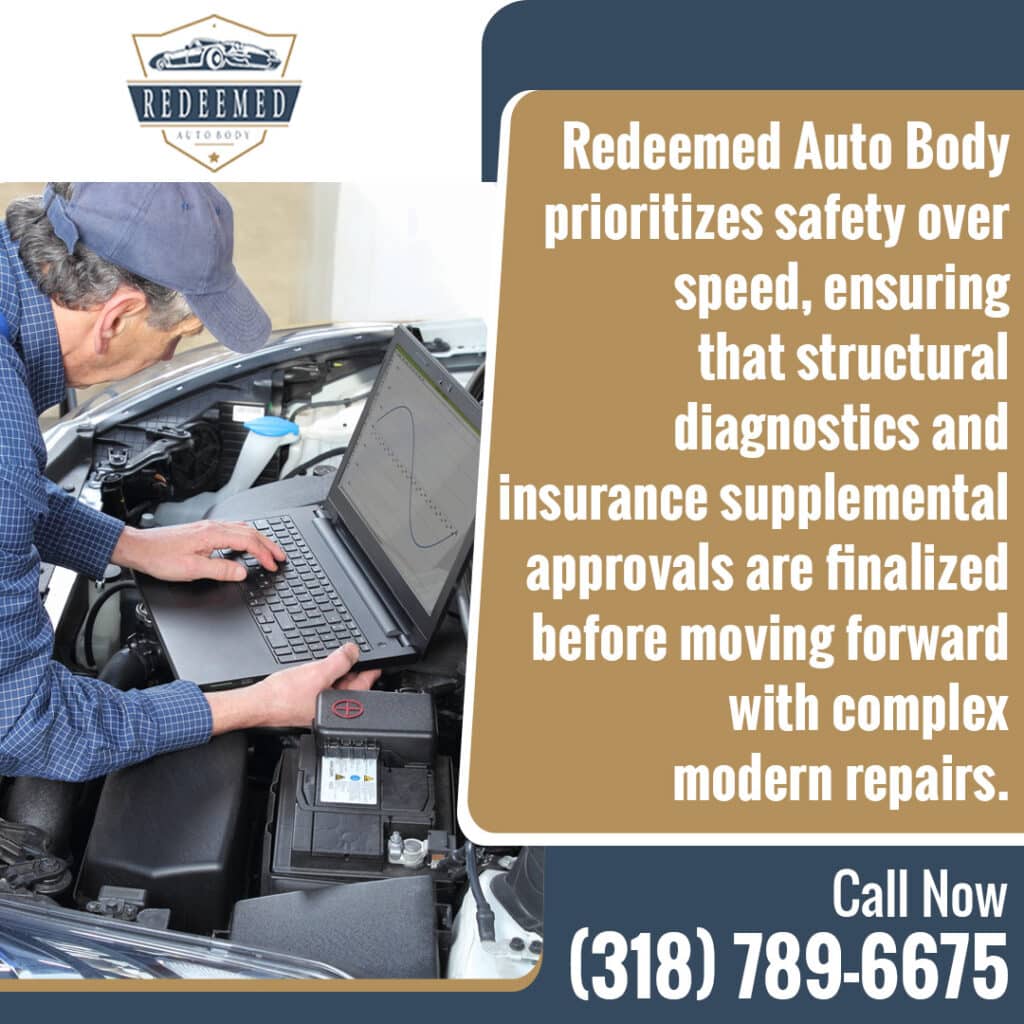
From there, we pull and follow every applicable OEM repair procedure. These manufacturer-specified steps are non-negotiable. Some repairs cannot begin until a prior step is verified and documented. Shops that skip steps to move faster often create bigger problems for you down the road.
Modern vehicles add complexity to every repair. Sensors, cameras, and safety systems are woven throughout your vehicle’s structure. Touching any one of them during a repair triggers a list of post-repair requirements before your vehicle is safe to drive again.
Minor Damage vs. Structural Collision Damage: Timeline Differences
The type and extent of damage to your vehicle sets the baseline for how long your repair will take.
Minor Cosmetic Repairs
Small dents, paint transfer, light panel damage, and minor bumper repairs can move faster as long as we do not find hidden structural damage underneath once we open things up. We complete many cosmetic jobs in three to five business days.
Even so, paint matching, color curing, and parts delivery all add time, and what looks minor can reveal deeper damage once a panel comes off.
Structural Collision Repairs
Structural auto collision repair: frame damage, suspension impact, multiple crushed panels, airbag deployment, or ADAS sensor damage typically takes two to four weeks, and sometimes longer.
We measure, document, and verify your vehicle at multiple stages. Frame straightening must meet OEM tolerances, and safety sensors require realignment before your vehicle is road-ready.
For us, safe repairs always come before fast ones.
| Damage Type | Typical Timeline | Key Variables |
| Minor dent or paint transfer | A few days | Hidden panel damage, paint curing |
| Bumper damage (moderate) | A few days to one week | Sensor replacement, parts arrival |
| Single panel replacement | One to two weeks | OEM part lead time, priming, and painting |
| Multi-panel or airbag repair | Tw to three weeks | Insurance supplements, structural checks |
| Frame or structural damage | Up to 30 days or more | OEM procedures, ADAS calibration, insurance |
Every vehicle and situation is different. Walt and the team will give you a realistic timeline after assessing your specific damage.
How Insurance Approvals Affect the Repair Schedule
One of the most common frustrations after an accident is waiting on insurance, and that delay is rarely our fault.
Our initial estimates are based on visible damage. Once we disassemble your vehicle, we often find damage that was not visible on the surface. We then submit a supplement to your insurer and must wait for approval before proceeding.
Insurance companies have different response times, different adjuster workflows, and different approval standards. Shops that participate in Direct Repair Programs (DRPs) often face pressure to minimize repair costs on behalf of the insurer, not the customer. We operate with zero DRP relationships. We work entirely for the person whose vehicle is in our shop.
When a supplement is needed, we handle the conversation with the insurer directly. We document everything: photos, OEM procedures, Spanesi Touch measurements, and we advocate for what your vehicle actually requires. That process takes time, but it produces the right result.
Understanding why insurance delays happen helps avoid misplaced frustration. The bottleneck is often an adjuster’s response queue, not ours.
OEM Parts Availability and Why It Matters
The parts your vehicle needs do not always arrive the next day. OEM parts are built to factory specifications and avoid the fitment and safety issues that aftermarket alternatives can introduce.
Some OEM components are backordered due to manufacturer production schedules, regional distribution, or limited availability for newer model years. Trucks or late-model vehicles with integrated technology are especially prone to delays.
We use OEM parts whenever possible and will never install aftermarket structural components that put your safety at risk. If you prefer a more economical option for non-structural parts, we can discuss that openly. The decision stays with you.
Why Vehicle Technology Adds Time to Modern Collision Repair
Modern vehicles carry electronics, cameras, radar, and driver-assistance systems throughout their structure/. Each of these creates repair requirements that did not exist a decade ago.
Pre-Scanning and Post-Scanning
Every vehicle we work on receives a pre-scan before any repair begins and a post-scan after all work is complete. We use AirPro and Opus diagnostic tools to read every module in your vehicle’s computer systems. These scans surface fault codes that are not visible from the outside, and they confirm that all systems are functioning correctly after the repair is done.
Your vehicle’s safety systems can look completely undamaged while carrying active fault codes from the collision. Those codes affect how your vehicle performs and can quietly disable safety functions, with no visible warning sign.
ADAS Calibration After Collision Repairs
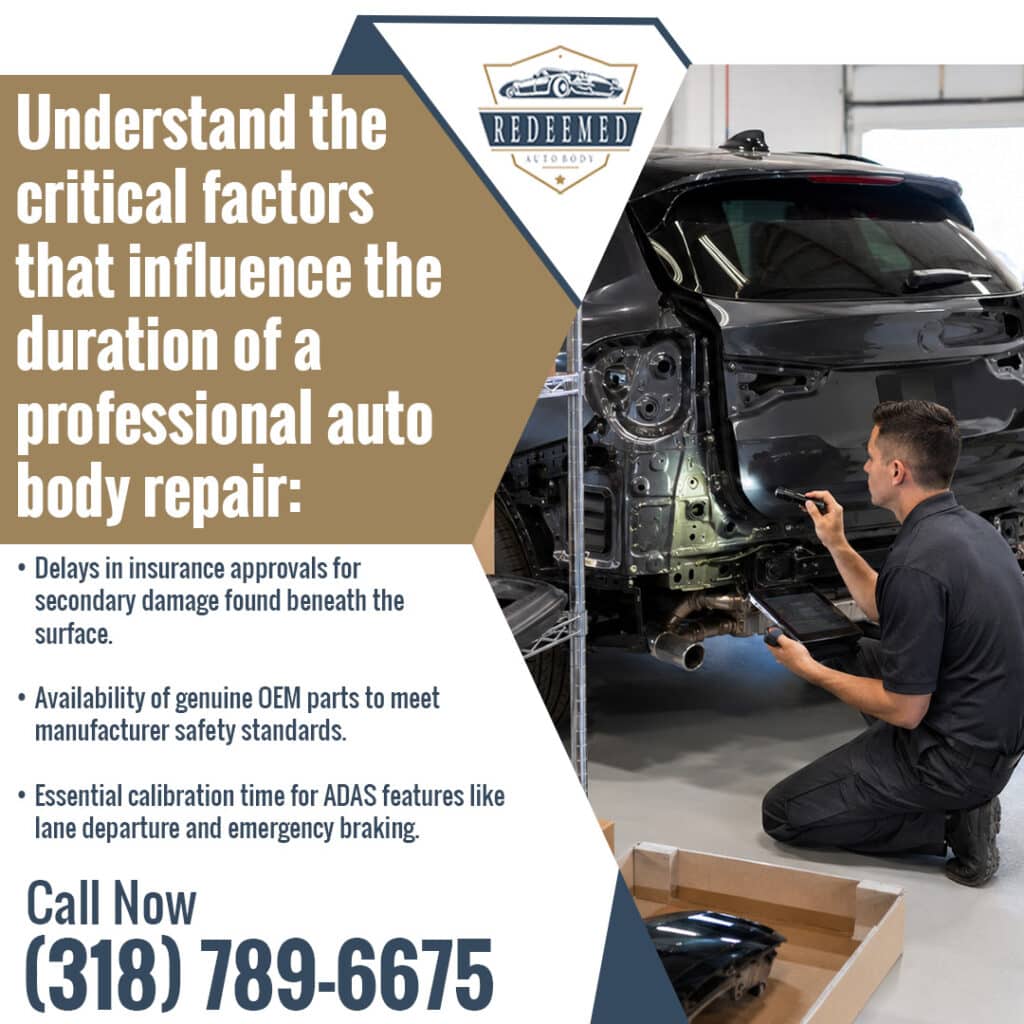
ADAS (Advanced Driver Assistance Systems) calibration is required after any repair that affects sensors, cameras, radar units, or your vehicle’s structural geometry. This covers lane departure warning, blind-spot monitoring, adaptive cruise control, automatic emergency braking, and backup cameras.
A sensor off by a small margin can fail when it matters most. We coordinate all ADAS calibrations through dealerships and manage that scheduling for you.
By the 2023 model year, 10 out of 14 ADAS features tracked by the NHTSA-partnered PARTS program had surpassed 50% market penetration in new U.S. passenger vehicles, with five features exceeding 90%.
Paint and Refinishing Cannot Be Rushed
Color matching starts before a single panel is sprayed. At Redeemed Auto Body, we use the AkzoNobel computerized color-matching camera to analyze your vehicle’s exact paint code along with any fade or color shift that has developed over time. Vehicle paint fades naturally with age and sun exposure. Spraying straight from the factory code without accounting for that shift produces a visible mismatch. This becomes obvious as soon as your vehicle is back in daylight.
After color is confirmed, the AkzoNobel paint system applies the finish in our semi-down draft paint booth. Panels are polished before reassembly begins. This sequence protects the quality and longevity of the finish, and it cannot be compressed without consequences.
Louisiana’s humidity and heat affect how paint cures. High humidity can interfere with adhesion. Returning your vehicle before the paint has fully cured risks bubbling, peeling, or adhesion failure. These are problems that show up weeks later and would require additional work to correct.
Your repair should look just as good at trade-in as it does on the day you pick your vehicle up. We do not cut corners in the refinishing process to speed things along.
Transparent Communication Reduces Repair Frustration
Delays feel longer when you do not know what is happening. The most common complaint we hear is not that a repair took too long; it is that no one communicated what was happening along the way.
We contact every customer at least twice per week with updates on completed work, pending parts, and insurance responses. If something changes your timeline, we’ll tell you before you have to ask.
Every customer also receives a dedicated Google Drive link containing photos, OEM repair procedures, Spanesi Touch measurements, and scan results from their repair.
This level of transparency is not just good service; it is how we put you in the driver’s seat throughout your repair. When a supplement is needed, you know why. When ADAS calibration adds time, you know what it involves. That knowledge turns an anxious wait into an informed one.
Our customers appreciate our clear communication. Here is a Google review by Ashley B. “Redeemed Auto Body far exceeded our expectations! They did outstanding collision and paint repair on our 2020 Ford Expedition. Communication was excellent throughout the process, the repair work was highly skilled, and the turnaround time was impressively quick. We’re extremely satisfied and would highly recommend them!”
Questions to Ask Before Choosing a Collision Repair Shop
Choosing the right collision center matters as much as how quickly you get your vehicle back. Ask these questions before you sign a repair order.
Does the Shop Follow OEM Repair Procedures?
The answer should be yes, without exception for structural repairs. OEM procedures are the manufacturer’s instructions for safely repairing their vehicle. Shops that deviate from these steps to save time or cost are taking shortcuts with your safety. Ask to see how the shop accesses and documents OEM procedures.
Will the Shop Use OEM Parts?
Structural components on your vehicle must always be OEM. Non-structural parts may have acceptable economical alternatives, but that decision should be yours, explained clearly before any parts are ordered. A shop that defaults to aftermarket structural parts without discussing it with you is not putting your safety first.
How Often Will You Get Updates?
A shop with no update process is a concern. Repairs lasting one to four weeks require active communication. Ask how often you will hear from the shop, who your contact is, and what documentation you will receive when your vehicle is returned.
Safe Repairs Should Always Come Before Fast Ones
Speed is not the right measure of a quality repair. If your vehicle is returned quickly but has not been properly scanned, measured, or calibrated, it still has unresolved problems.
Our goal is that your vehicle passes every post-repair check, holds its resale value, and shows no evidence of the collision. That is what quality collision repair services are built around.
At Redeemed Auto Body, every repair and paint job is backed by a Limited Lifetime Warranty, covering workmanship and paint for as long as you own the vehicle. That warranty only means something because the repair behind it was done correctly the first time.
According to NHTSA, 6.1M police-reported traffic crashes occurred in the United States in 2023, resulting in more than 2.4 million injuries. Proper structural repair after a collision directly affects how your vehicle performs in any subsequent impact.
Your vehicle’s frame, if not restored to OEM tolerances, will protect you less in any subsequent impact, regardless of how the exterior looks. That is why the quality of your repair, not how fast it was done, is what actually keeps you safe.
Frequently Asked Questions
Can hidden damage extend the repair timeline?
Yes, and it happens often. Damage to your vehicle’s inner panels, frame rails, suspension components, or wiring is not always visible until we disassemble your vehicle. When we find hidden damage, we document it, submit a supplement to your insurer, and keep you informed before any additional work begins.
Why do parts delays happen after an accident?
High-demand components, newer model years, and storm-season surges can all extend OEM parts delivery times. We order parts as soon as your insurance approves.
How long does paint curing take?
Most modern automotive paint systems cure fully within 24 to 48 hours under controlled conditions. Louisiana’s humidity can extend that window. We polish panels after painting and before reassembly to confirm the finish has properly set. This step protects the appearance and durability of the final repair.
Should collision repairs ever be rushed?
No. A rushed repair that skips pre- or post-scans, uses non-OEM structural parts, or cuts paint curing time short may look acceptable on delivery day, but problems often appear weeks later. When searching for collision repair near you, prioritize shops that follow OEM procedures over those that promise the fastest turnaround.
Ready to Get Your Vehicle Repaired the Right Way?
An accident is stressful enough. You should not have to wonder whether your vehicle was fixed properly, whether the right parts were used, or whether your insurance claim was handled in your favor.
At Redeemed Auto Body, we handle all of that for you, from the first scan to the final quality check, with open communication every step of the way. Contact us at (318) 789-6675 or redeemedautobody@gmail.com for collision repair services in West Monroe, LA. We also serve Monroe and the surrounding Ouachita Parish area. Consultations are always free. Our experienced technicians work to restore your vehicle’s safety, reliability, appearance, function, and value.