Synopsis:
A professional collision damage assessment identifies all visible and hidden damage after an accident using inspections, diagnostics, measurements, and OEM research. This process guides accurate repair planning, supports insurance documentation, and protects your vehicle’s safety, performance, and long-term value when completed correctly.
A professional collision damage assessment is a systematic evaluation that identifies visible and hidden damage after an accident. The process includes visual inspection, electronic diagnostics, structural measurements, OEM research, and documentation to build an accurate repair plan. This assessment determines what repairs your vehicle needs to restore its safety, function, and appearance. At our West Monroe, LA facility, Redeemed Auto Body conducts thorough assessments because proper evaluation prevents missed damage and protects your vehicle’s long-term reliability.
What Is a Collision Damage Assessment and Why Does It Matter
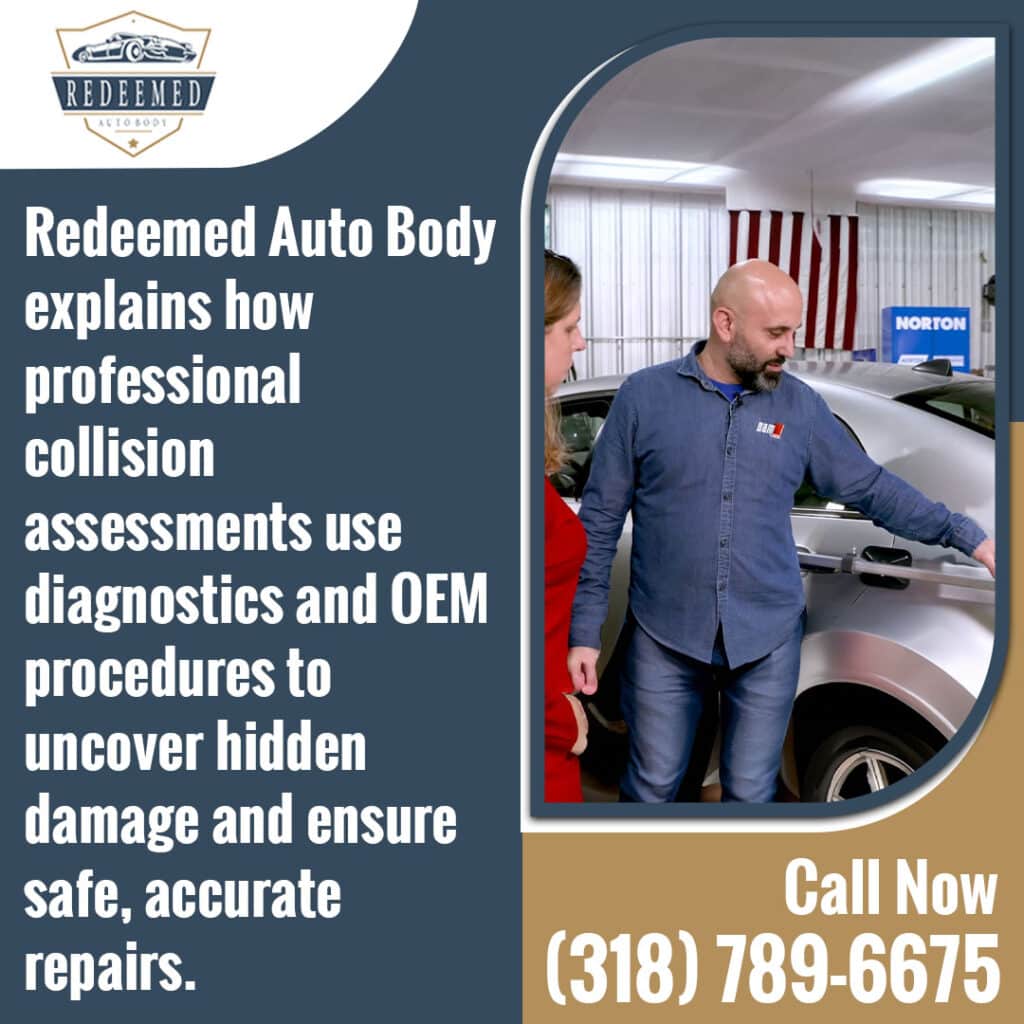
A collision damage assessment is a detailed inspection that reveals all damage to your vehicle after an accident, including problems you cannot see.
Modern vehicles contain complex electronics, advanced materials, and safety systems that can sustain damage without visible signs. A fender that looks fine might hide sensor brackets that shifted during impact. Paint that appears intact might cover buckled metal underneath.
Modern crash avoidance features rely on sensors to detect potential collisions, requiring professional inspection after impacts to verify functionality.
Insurance photos capture surface damage but miss structural shifts, electrical faults, and hidden component damage. Anyone searching for collision repair near them needs a facility equipped with diagnostic scanning tools and precision measuring systems that performs complete assessments, not quick estimates based on photos. Professional evaluation protects your safety and prevents repair failures.
When a Collision Damage Assessment Takes Place
The assessment begins when you bring your vehicle to our collision center. This evaluation happens before ordering parts or starting repairs because accurate damage identification prevents delays and ensures proper planning.
Many collision repair services discover additional damage during disassembly, which requires supplements to the original estimate. We schedule dedicated assessment time rather than rushing through inspections. Our technicians follow systematic evaluation procedures so that nothing gets missed. The time invested during assessment saves weeks of potential delays caused by discovering damage mid-repair.
Step One: Initial Visual Inspection and Customer Intake
Reviewing Accident Details and Vehicle History
We start by discussing how the accident occurred during the initial consultation and evaluation. Impact direction, speed, and collision type help us predict where damage is likely to exist. Your description guides our inspection focus for proper auto collision repair.
We look over the car and discuss insurance options with you. This information helps us distinguish new damage from existing conditions and ensures we address everything correctly. Understanding whether your vehicle has been in prior accidents affects how we approach the assessment.
Identifying Obvious Exterior Damage
The visual walk-around documents panels, lights, glass, and paint damage. We photograph everything and note visible alignment issues. We check panel gaps, door operation, and hood and trunk alignment. These visual indicators often point to underlying structural problems discovered at our collision center that require deeper investigation. Surface observations cannot reveal what happened to the structure, electronics, or internal components during impact.
Step Two: Electronic Diagnostics and Vehicle Scanning
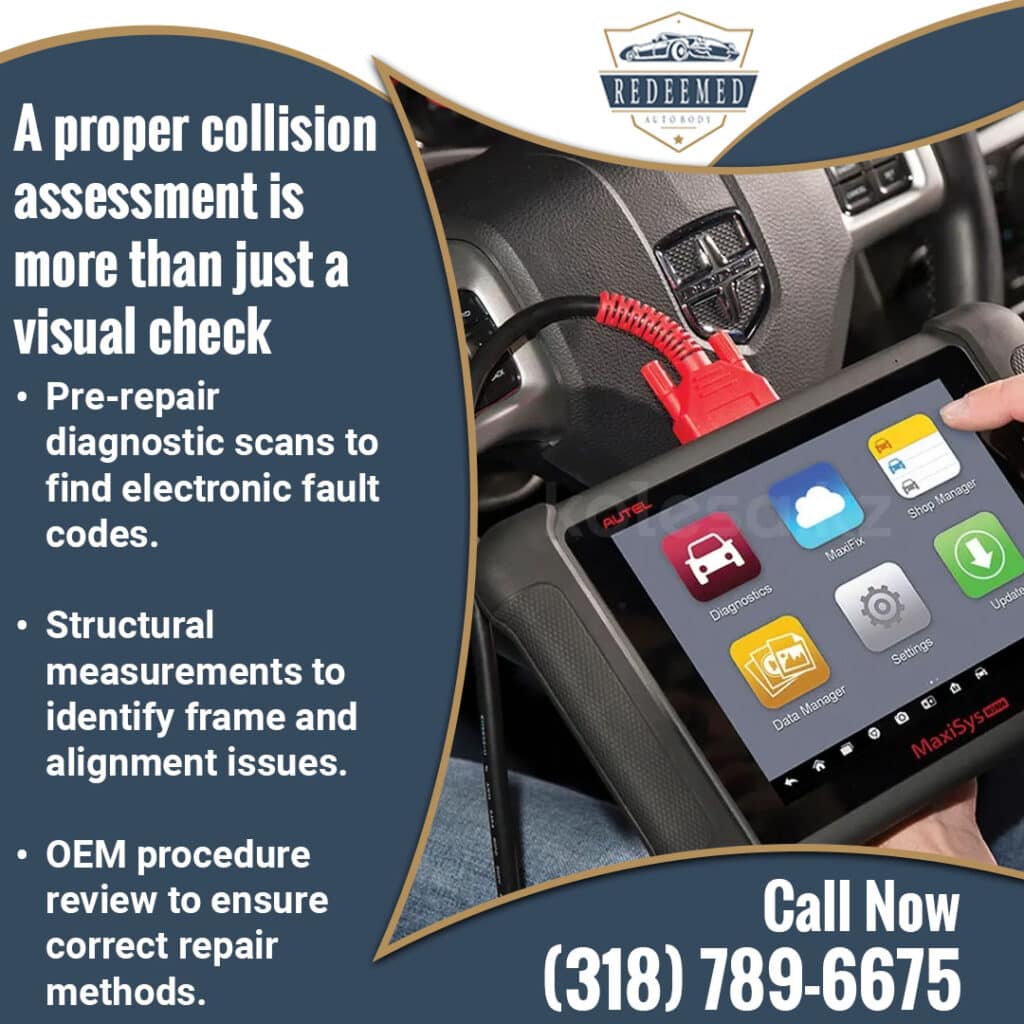
Modern vehicles store fault codes after collisions. These codes indicate which systems experienced problems during impact, even when those systems still appear to function. At Redeemed Auto Body, we prescan all computers using our AirPro and Opus diagnostic tools to perform comprehensive pre-repair scanning on every vehicle.
Pre-repair scanning checks multiple systems:
- Airbag modules and supplemental restraint systems
- Electronic stability control and anti-lock braking systems
- Adaptive cruise control and lane departure warning
- Forward collision avoidance and blind spot monitoring
- Parking assist sensors
Vehicles that have been involved in collisions frequently set diagnostic trouble codes requiring scans to restore electronic systems, per industry guidelines from I-CAR and OEMs.
The data tells us which sensors need replacement, which modules need reprogramming, and which systems need recalibration after repairs. Without this step, auto collision repair services risk returning vehicles with compromised safety features. We document all fault codes and use them to build the complete repair plan.
Step Three: Measuring Structural and Frame Integrity
Why Frame and Structural Accuracy Is Critical
Your vehicle’s structure maintains proper wheel alignment, handling characteristics, and crash protection. Even small structural shifts affect how your vehicle drives and how it protects occupants in future accidents. Structural damage often exists without visible exterior signs. A vehicle can look straight but measure out of specification.
How Precision Measuring Identifies Hidden Damage
We use our Spanesi Touch measuring system to compare your vehicle’s dimensions against manufacturer specifications. This three-dimensional measuring technology detects shifts measured in millimeters. We check dimensions at multiple structural points, including frame rails, rocker panels, strut towers, and suspension mounting points.
This process reveals damage that visual inspection misses and guides repair planning. The measuring system provides documentation showing exact deviation from specifications. This data supports insurance claims and proves repair necessity. Precision measuring separates professional collision repair services from facilities that rely on visual estimates alone.
Step Four: OEM Repair Research and Documentation
Original Equipment Manufacturer repair procedures specify exactly how each vehicle should be repaired. These procedures vary by make, model, and year because manufacturers use different materials, joining methods, and structural designs.
We obtain and follow OEM procedures for your specific vehicle. These documents tell us which parts can be repaired versus replaced, which welding techniques to use, where heat application is acceptable, and which adhesives meet structural requirements. For example, some aluminum panels require specific rivet types and spacing patterns, while steel panels need different welding settings.
We create an OEM repair plan and download all OEM procedures, then create a Google Drive link for each customer and load all documents for repairs. This transparent communication shows everything being done to your vehicle at our collision center. Following OEM procedures is non-negotiable for collision repair in West Monroe, LA, at Redeemed Auto Body because your safety depends on correct methods.
Step Five: Building a Complete Repair Plan
Parts Identification and Fitment Planning
Once the repair plan is approved, we order parts and document them with photos. Parts lists include OEM part numbers to ensure correct fitment. We use OEM factory parts as much as possible to maintain your vehicle’s safety and value. There are instances when customers decide to use a more economical option, but we never compromise safety and will not install aftermarket structural parts.
We check parts availability and lead times because some components require weeks for delivery, which affects repair scheduling. Accurate parts identification prevents ordering errors that delay completion of your auto collision repair.
Labor Operations and Repair Sequencing
Repair sequencing determines which work happens in what order for quality collision repair services. Body and metal repair come first. We measure the vehicle with our Spanesi Touch system and complete all structural straightening. We pre-fit all the parts to ensure proper fitment before moving to the next phase.
Next, we prime and paint using our AkzoNobel paint system. We use a color-matching camera to ensure the correct color for painting. Before reassembly, polishing is done to achieve a flawless finish. Final reassembly happens after all paintwork is complete. We perform post scans and handle any alignments that need to be done. When ADAS calibrations are required, we coordinate with certified dealers to ensure proper recalibration.
Step Six: Insurance Coordination Without Compromising Repairs
We work for you, not your insurance company. Our assessment documents all necessary repairs using OEM procedures and industry-standard labor times. We help you manage the claim. Together, we work to help you obtain proper reimbursement.
Insurance adjusters sometimes write estimates based on photos before seeing the vehicle. Those initial estimates often miss damage that becomes apparent during disassembly. We communicate with the customer and the insurance to gain approval for the safe repairs at our collision center.
According to CCC Intelligent Solutions’ 2025 industry data, diagnostic scans are included in most auto repair appraisals, and calibration procedures are increasingly common, appearing on approximately one-third of repair estimates and frequently added as supplemental items once technicians begin teardown. This trend underscores how invisible vehicle technology damage can go undetected in photo-based estimates.
We photograph hidden damage as we discover it, providing visual proof that supports supplement requests. We explain to your insurance company why additional repairs are necessary and why they meet OEM requirements.
Under Louisiana insurance law (La. R.S. 22:1892), consumers have the right to select any licensed repair facility for their collision repairs, and insurers cannot mandate where work must be done. Insurance companies may recommend preferred provider networks, but they cannot legally force you to use them. We gladly work with all insurance companies to assist our clients in obtaining the highest quality repair. However, once your vehicle is placed in our care, we work for you. We have a conversation to help you get the best repair possible through quality collision repair services.
Step Seven: Quality Control Before Repairs Begin
Before starting repairs, we review the complete repair plan. This final check confirms that all damage has been identified and that our plan addresses every issue correctly. We verify parts orders and confirm OEM procedure availability. Our equipment and training support the required repair methods for quality collision repair services.
We check that all necessary materials are available. We confirm which systems will need post-repair scanning and coordinate ADAS recalibration requirements before beginning work. This preparation allows a smooth workflow without delays. We communicate with you about the complete repair scope and expected timeline before starting work at our collision center.
What Vehicle Owners Should Expect During the Assessment Process
Clear Communication Throughout the Process
We explain what we find, why it matters, and how we plan to address it. We communicate with customers twice a week to keep them informed throughout the repair process at our collision repair shop.
Detailed Photo Documentation
Photo documentation shows you the damage and supports insurance claims for collision repair services. We photograph visible damage and document diagnostic findings. These images become part of your permanent repair record stored in your Google Drive folder.
Adequate Time for Thorough Evaluation
Proper assessment takes time. Simple accidents may require a day. Complex collisions involving multiple systems might need several days for complete evaluation. We never rush evaluation to meet artificial deadlines because quality matters more than speed.
Complete Transparency and Involvement
We put you in the driver’s seat and help you make educated decisions about your vehicle repairs. We answer questions, explain technical findings in plain language, and provide documentation you can review. This approach reflects our commitment to customer care and service.
Why a Professional Collision Damage Assessment Protects Your Vehicle’s Safety and Value
A thorough assessment protects your safety by ensuring all damage gets addressed. Missed structural damage affects handling and crash protection. Undiagnosed electronic problems compromise advanced safety systems that prevent accidents.
Proper repairs maintain your vehicle’s resale value. Documented repairs following OEM procedures preserve value because they restore your vehicle correctly. When you trade or sell your vehicle, proper repair documentation demonstrates quality work. A repair done right means you cannot tell the car has been repaired, and when you resell or trade it in, it looks like new.
Choosing the Right Collision Center in West Monroe, LA
Professional collision repair facilities invest in diagnostic equipment, measuring systems, and OEM repair procedure access. These tools separate a thorough assessment from quick visual estimates.
Key capabilities to look for:
- Pre-repair scanning with professional diagnostic tools
- Structural measuring systems for precision verification
- OEM repair procedure database access and compliance
- Clear documentation and communication practices
- I-CAR Platinum certified technicians
- Investment in specialized repair equipment
We maintain I-CAR Platinum-certified technicians, demonstrating our commitment to proper training. We invested in Spanesi Touch measuring equipment, AirPro and Opus diagnostic tools, and Prospot welders because correct repairs require the right tools. Our paint technicians use AkzoNobel paint systems to ensure proper color matching and finish quality.
Ask potential shops about their diagnostic capabilities, measuring equipment, and OEM procedure compliance to find options for quality collision repair near you in West Monroe, LA.
The Assessment Is the Most Important Step in Collision Repair
Assessment accuracy determines repair quality. Thorough evaluation identifies all damage, follows manufacturer specifications, and creates repair plans that restore your vehicle’s safety and function. Skipping assessment steps or rushing evaluation leads to missed damage and incomplete repairs.
At Redeemed Auto Body, we conduct thorough assessments because your safety matters. Our customer care and service are unparalleled. When you need collision repair in West Monroe, LA, a proper assessment starts your vehicle on the path to correct restoration.
Contact us at (318) 789-6675 or email redeemedautobody@gmail.com to schedule your free consultation. We provide transparent evaluation and help you make informed decisions about your vehicle repairs.
Recent Posts
Top Auto Body Care Resolutions For Vehicle Owners This New Year
How Cold Weather in West Monroe Can Reveal Missed Collision Damage