Synopsis
After a collision, damage may affect either your vehicle’s structural safety systems or only its exterior appearance. Redeemed Auto Body explains how to identify each type, why the distinction matters for protection and resale value, and how proper repair procedures restore performance, alignment, and finish quality with documented precision.
After a vehicle collision, damage falls into two distinct categories that affect your repair approach, safety, and costs differently. Structural damage includes damage to the frame, unibody, or integrated reinforcement components that are engineered to absorb and redistribute crash forces and protect occupants. Whether a reinforcement part is structural depends on how the manufacturer integrates it into the vehicle’s protective structure.
Cosmetic damage affects exterior panels and appearance without compromising structural integrity. This distinction matters for your safety, insurance claims, and vehicle resale value. Whether you’re searching for collision repair near you in West Monroe, LA, or the surrounding communities, knowing the difference helps you make informed choices about your vehicle’s care. Redeemed Auto Body is a collision center with a dedicated team that works tirelessly for you. We guide vehicle owners through every repair decision with complete transparency.

What Is Structural Collision Damage?
Structural damage affects your vehicle’s frame, unibody, or reinforcement components that form the protective safety cage around occupants. These elements create the foundation of your vehicle and are engineered to absorb and redirect crash forces away from passengers during impact.
Parts of the Vehicle Considered Structural
Your vehicle’s safety depends on multiple structural components functioning as an integrated system. Frame rails extend lengthwise underneath and serve as the primary load-bearing foundation. Unibody construction merges the frame and body into one unified structure used in most modern passenger vehicles. Crumple zones compress during collisions to absorb impact energy before it reaches occupants.
Core support structures hold the radiator and front-end assembly while adding rigidity. Pillars labeled A, B, and C from front to rear support the roof and provide rollover protection. Suspension attachment points must maintain exact positioning for safe handling and tire wear. Each component meets precise engineering tolerances that determine how effectively your vehicle protects you.
Advanced chassis measuring systems, such as the Spanesi Touch, detect dimensional deviations from manufacturer specifications that a visual check alone may miss, helping ensure proper structural alignment.
Why Structural Damage Is a Safety Issue
Compromised structural components prevent your vehicle from protecting you as designed. When frame rails bend or buckle, crash energy distribution shifts, potentially directing forces toward passengers instead of dissipating them safely. Steering and alignment depend on frame accuracy. Even small distortions create handling issues and accelerate tire wear.
Many modern vehicles with ADAS features require sensor recalibration after collision repair if impact, suspension, or body alignment affects sensor mounting or reference points. Proper diagnostic tools ensure calibrated systems operate within manufacturer tolerances. Airbag deployment depends on structural integrity. Compromised structures may cause airbags to malfunction during subsequent crashes. We follow manufacturer repair procedures to preserve these engineered safety features exactly as intended.
What Is Cosmetic Collision Damage?
Cosmetic damage affects exterior panels and vehicle appearance without impacting the underlying structural framework. These repairs restore your vehicle’s looks while protecting surfaces from environmental damage like rust and corrosion.
Examples of Cosmetic Damage
Surface-level damage typically includes dents in body panels that haven’t disturbed the structure beneath. Paint scratches and surface marks affect appearance without altering function. Bumper covers, the plastic exterior shells, often sustain damage while the reinforcement bar behind them stays intact. Paint transfer from other vehicles frequently buffs away or washes off. Minor panel creases may require body repair without raising structural concerns.
When Cosmetic Damage Still Requires Professional Attention
What appears purely cosmetic often deserves professional inspection. Hidden panel warping may signal underlying structural problems invisible from the outside. Failed paint protection leads to rust spreading underneath surfaces, eventually requiring extensive correction. Bumper sensor misalignment affects parking assistance, blind spot detection, and collision warning systems.
Lease return evaluations examine panel fitment, paint condition, and repair quality closely. Trade-in values drop when buyers spot poor workmanship or color mismatches. Our AkzoNobel color-matching technology helps determine whether damage stops at the surface or extends into structural components.
How Can You Tell If Damage Is Structural or Cosmetic?
Visual checks offer initial clues, but professional collision repair diagnosis reveals the full extent of damage.
Signs of Possible Structural Damage
Multiple warning signs point to a structural compromise that needs professional collision repair services. Uneven spacing between doors, fenders, and body panels suggests misalignment tracing back to frame distortion. Vehicles that drift to one side indicate suspension mounts or frame rails have shifted position. Off-center steering wheels while driving straight reveal alignment problems caused by frame irregularities.
Abnormal tire wear, especially concentrated on one corner, often results from frame damage affecting suspension angles. Visible creases, buckles, or bends in frame rails confirm direct structural impact. Doors that stick or don’t latch properly, plus windows that bind in channels, frequently stem from the body structure being knocked out of position.
Why Visual Inspections Are Not Enough
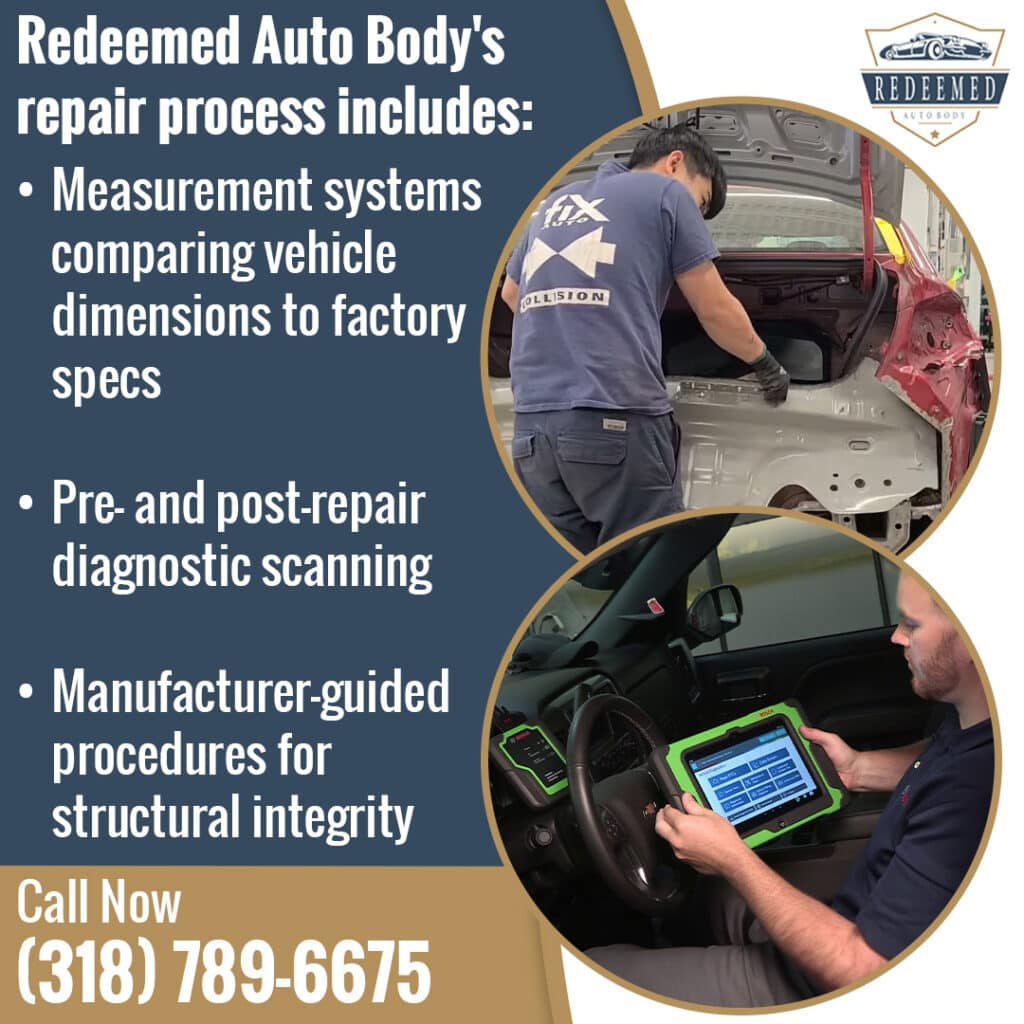
Collision damage hides behind panels and beneath painted surfaces. Our Spanesi Touch measuring system compares your vehicle’s actual dimensions to manufacturer specifications with millimeter precision. Electronic pre-scans and post-scans using AirPro and Opus diagnostic tools identify faults in sensors, control modules, and safety systems that visual checks miss entirely.
Manufacturer repair planning documents every step in detail. We create a Google Drive folder for each customer containing all procedures, measurements, and documentation for your specific vehicle. This transparency shows you exactly what your vehicle requires and our reasoning. Computerized measuring combined with diagnostic scanning provides the complete structural integrity picture.
Why Structural Collision Repair Requires Specialized Equipment
Modern auto collision repair demands purpose-built equipment matching today’s vehicle technology. Our frame bench secures vehicles while hydraulic systems pull frame rails and unibody sections back to factory dimensions. The Spanesi Touch computerized measuring system at Redeemed Auto Body provides instant feedback during the straightening process.
Specialized welding equipment, including our Prospot MIG and MAG welders, handles high-strength steel and aluminum because current vehicles combine different metals throughout their construction. Incorrect welding techniques or equipment settings weaken structural strength permanently. AirPro and Opus diagnostic scanners at our collision center interface with vehicle computers to detect hidden damage and confirm successful repairs.
The Insurance Institute for Highway Safety reports that contemporary vehicle structures use advanced materials and engineering requiring manufacturer-specific repair methods. Adhering to these procedures maintains safety systems exactly as designed. Our I-CAR Platinum-certified technicians use this specialized equipment to restore vehicles to pre-accident safety standards.
Does Insurance Treat Structural and Cosmetic Damage Differently?
Insurance carriers evaluate damage based on the extent of repair needed, safety implications, and cost relative to the vehicle’s value. Structural repairs often influence total-loss decisions and diminishment in value more significantly than surface-level repairs.
Repair Planning vs. Initial Estimates
First estimates frequently overlook hidden damage appearing during disassembly. Supplemental claims, additional damage documentation submitted after disassembly begins, represent standard industry practice. Frame distortion may hide behind undamaged bumper covers. Electrical system faults may surface only after diagnostic scanning occurs.
We help you manage the insurance claim process. Working together, we pursue proper reimbursement for necessary repairs. Our discussions focus on achieving the best outcome for your vehicle rather than accepting the lowest estimate.
Why You Have the Right to Choose Your Collision Center
Under Louisiana insurance regulations, you have the right to choose your collision repair facility; insurers can recommend shops but cannot require you to use a specific one. Insurance companies sometimes recommend Direct Repair Program shops, but you face no obligation to use them. Independent collision repair shops work for you instead of insurance carriers. We build repair plans around your vehicle’s actual needs using OEM parts and procedures, then advocate for appropriate coverage.
This becomes critical when structural work is involved. Shops emphasizing speed over quality may shortcut measuring, welding, or parts selection. Your safety depends on repairs executed correctly from the start.
Why Structural Repair Quality Protects Your Vehicle’s Value
Frame condition directly influences resale pricing. CarFax and AutoCheck reports flag structural damage, alerting buyers to collision records. Buyers typically reduce offers by thousands for vehicles showing structural damage history.
Kelley Blue Book (KBB) studies show vehicles with accident records lose a percentage of value, depending on the extent of damage. Quality collision repair minimizes value reduction by returning vehicles to manufacturer specifications. We use OEM parts and follow manufacturer procedures to maintain your vehicle’s value.
Safety liability extends beyond financial considerations. Improper structural repair that fails to return the vehicle to manufacturer-specified tolerances can compromise crash performance and occupant protection. Long-term performance suffers when frame geometry stays incorrect, producing tire wear and handling deficiencies.
| Collision Damage Impact on Resale Value | Typical Value Reduction |
| Minor cosmetic damage (quality restoration) | 5-10% |
| Moderate structural damage (quality restoration) | 10-15% |
| Severe structural damage (quality restoration) | 15-25% |
| Any damage level (substandard restoration) | 25-40% |
These figures reflect KBB-guided 17c appraisals used in claims.
Why Cosmetic Repair Quality Still Matters
Cosmetic auto body repair requires precision technology for invisible results. Our AkzoNobel computerized color matching camera analyzes your vehicle’s exact paint shade, accounting for factory variations and sun fading over time. Contemporary automotive finishes include multiple layers: primer, color base coat, and protective clear coat, each needing specific application methods.
Rust prevention begins with thorough surface preparation. Exposed metal requires treatment and sealing to stop corrosion from developing underneath new paint. Panel alignment preserves factory spacing between body components. Poor alignment looks unprofessional and may permit water leaks.
Color blending into adjacent panels creates seamless transitions. Repainting only damaged sections often produces noticeable color variations. We blend into surrounding panels for a uniform appearance across the entire vehicle. These refinements matter to drivers wanting invisible repairs that don’t reduce resale appeal or trigger lease return charges.
What Happens During Professional Collision Repair in West Monroe, LA?
The collision repair process at Redeemed Auto Body follows structured phases emphasizing quality and transparency. Initial consultations assess damage extent and review insurance considerations. We examine your vehicle and explain the complete repair scope.
Computer pre-scanning happens before any work begins, identifying existing diagnostic codes and system problems. Repair planning downloads manufacturer procedures specific to your vehicle’s year, make, and model. Every procedure gets documented in your dedicated Google Drive folder for complete transparency.
Frame verification using our Spanesi Touch measuring system confirms dimensional accuracy. Body technicians restore panels and structural elements. Our AkzoNobel paint system with computerized color matching delivers superior results during refinishing. Reassembly involves the precise fitment of every component.
Post-repair computer scanning verifies that all vehicle systems operate correctly. Quality verification includes test driving, lighting checks, and confirming every component functions as intended. We schedule delivery and review all completed work with you personally.
When Should You Schedule Collision Repair?
Timing significantly impacts collision repair outcomes. Book your appointment immediately after accidents, even when your vehicle seems drivable. Hidden damage worsens progressively as components shift during normal operation.
When metal is exposed due to collision damage, it rusts rapidly. Louisiana’s humidity accelerates this corrosion process substantially. Address paint damage before rust spreads beneath surfaces. Schedule repairs ahead of lease returns or vehicle sales to maximize value. Professional documentation demonstrates quality workmanship to future buyers.
Structural vs. Cosmetic Damage Comes Down to Safety and Precision
Structural damage compromises engineered safety systems that protect occupants during collisions. Cosmetic damage affects appearance and surface protection from environmental factors. Both categories require collision repair services from qualified professionals. Distinguishing between these damage types determines the repair approach, equipment requirements, and long-term consequences for safety and value preservation.
At Redeemed Auto Body, we restore vehicles following manufacturer procedures, using OEM factory parts and advanced measuring technology. Our commitment to customer service means putting you in control of repair decisions with complete information. We work with your insurance company to help secure appropriate reimbursement for necessary repairs backed by our Limited Lifetime Warranty.
Not all body shops are the same. Quality collision repair in West Monroe, LA requires transparency, specialized equipment, and unwavering attention to safety. Contact us at (318) 789-6675 or redeemedautobody@gmail.com to schedule your free consultation. We serve West Monroe and neighboring communities with services designed to restore your vehicle’s safety, appearance, and long-term value.
Recent Posts

How to Spot Hidden Damage After a Minor Fender Bender in West Monroe, LA

What Happens During a Professional Collision Damage Assessment